 Residency


 App of the Day
from the creators of
 murmur
 Layered
The Statutory Residence Test decides whether you are UK resident for a tax year. HMRC's guidance, RDR3, sets it out as steps. This page follows that order.
This guide explains how the count works, with the official source for every figure. Rules change and your own circumstances matter, so check the source and take decisions to an adviser.
Step 1: 183 days
If you spend 183 days or more in the UK in the tax year, you are UK resident. If you spent fewer, go on.
Step 2: the automatic overseas tests
Meet any one of these and you are not UK resident for the year.
- First test. You were UK resident in one or more of the previous three tax years, and you spend fewer than 16 days in the UK.
- Second test. You were UK resident in none of the previous three tax years, and you spend fewer than 46 days in the UK.
- Third test. You work full-time overseas, spend fewer than 91 days in the UK, work more than three hours in the UK on fewer than 31 days, and have no significant break from the overseas work.
Step 3: the automatic UK tests
If you met none of the overseas tests, meeting any of these makes you resident.
- 183 days or more in the UK in the tax year.
- A home in the UK. There is a period of at least 91 consecutive days when you have a UK home, at least 30 of those days fall in the tax year, you are present in the home on at least 30 days, and you have no overseas home or are present in it on fewer than 30 days.
- Full-time work in the UK for a period of 365 days, where more than 75% of your working days in that period are UK working days and at least one of them falls in the tax year.
Step 4: the sufficient ties test
If no automatic test settled it, your ties and your days are read together. The ties are family, accommodation, work and a 90 day tie, plus a country tie if you were resident in any of the previous three tax years. The more ties you have, the fewer days you can spend in the UK.
| Days in the UK in the tax year | Resident in one of the last 3 years | Resident in none of the last 3 years |
|---|---|---|
| 16 to 45 | Resident with at least 4 ties | Not resident |
| 46 to 90 | Resident with at least 3 ties | Resident with all 4 ties |
| 91 to 120 | Resident with at least 2 ties | Resident with at least 3 ties |
| Over 120 | Resident with at least 1 tie | Resident with at least 2 ties |
What the test asks of your records
Every step turns on a day count: days in the UK, days in a home, days worked. HMRC can reduce the count for exceptional circumstances and increase it under a deeming rule, so the count you keep needs dates you can stand behind.
In Residency
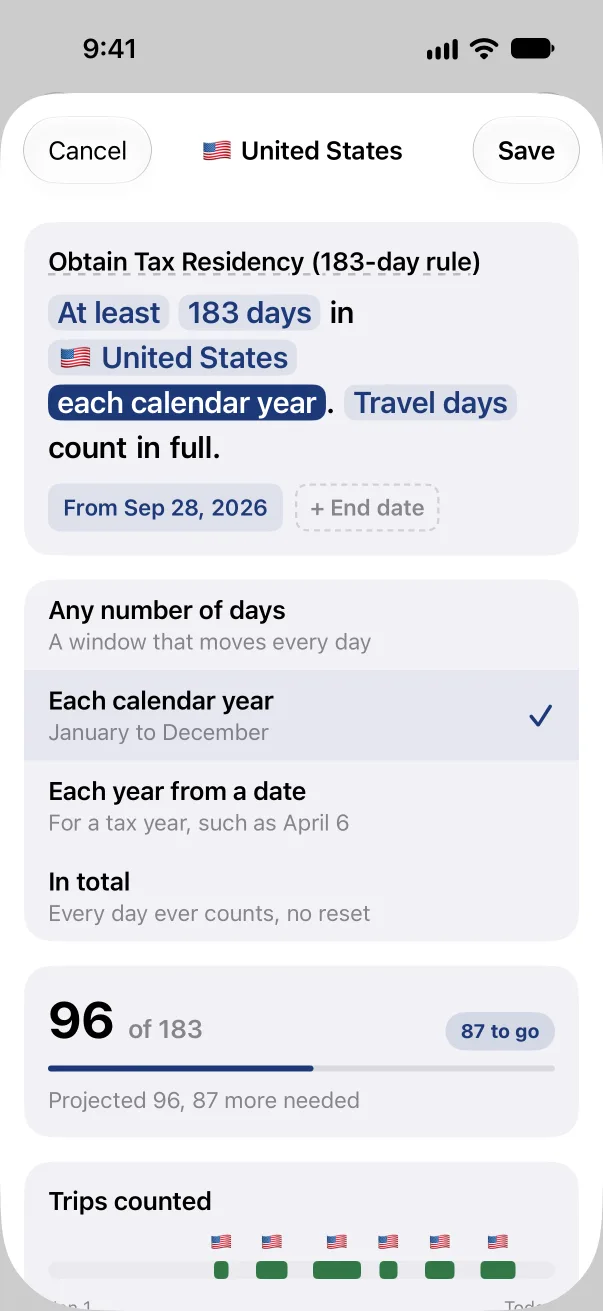
Residency keeps the day count for each country as you travel and rebuilds the past from your photo library. It warns you before a trip takes you past a threshold you have set.
Updated 11 November 2026.
Questions
How many days can I spend in the UK without becoming tax resident?
It depends on your ties and your history. HMRC's tables run from 16 days, if you were recently resident and have four ties, to over 120 days. At 183 days you are resident whatever your ties.
What is the order of the Statutory Residence Test?
First the 183-day check, then the automatic overseas tests, then the automatic UK tests and the sufficient ties test.
What counts as a UK tie?
HMRC lists a family tie, an accommodation tie, a work tie and a 90 day tie, plus a country tie if you were resident in one of the last three tax years.