 Residency


 App of the Day
from the creators of
 murmur
 Layered
"Stay under 183 days" is the best-known rule in tax residency and the least reliable. The number is real, but each country counts it its own way, and most have other tests beside it.
This guide explains how the count works, with the official source for every figure. Rules change and your own circumstances matter, so check the source and take decisions to an adviser.
Five countries, side by side
| Country | What is counted | Over what period | What else matters |
|---|---|---|---|
| United Kingdom | 183 days or more makes you resident | The tax year | Fewer days can still make you resident through a home, full-time work or ties |
| United States | A weighted total of 183: all of this year's days, a third of last year's, a sixth of the year before | Three calendar years, with at least 31 days in the current one | Exceptions and treaties can change the result |
| Canada | Fewer than 183 days is one condition for being a non-resident | The tax year | Significant residential ties come first |
| Spain | More than 183 days makes you resident | The calendar year | Occasional absences count as days in Spain unless you prove tax residence elsewhere |
| Australia | More than half the income year makes you resident | The income year | Not if your usual place of abode is outside Australia and you do not intend to take up residence |
What the table tells you
The year is not always the calendar year. The UK and Australia count over their own tax years. Spain and the United States use the calendar year.
Earlier years can count. The United States carries a share of the last two years into this year's total. The UK does not weight earlier years, but its ties test asks whether you were resident in any of the last three tax years.
Days are rarely the whole test. The UK asks about your home and your work. Canada starts from residential ties. Australia asks where your usual place of abode is. Spain counts your absences against you unless you can show residence elsewhere.
What to do with this
Count your days in each country you spend time in, for the year that country uses. Treat 183 as the line you can see and the other tests as lines you cannot, and get advice before you rely on being on the right side of either.
In Residency
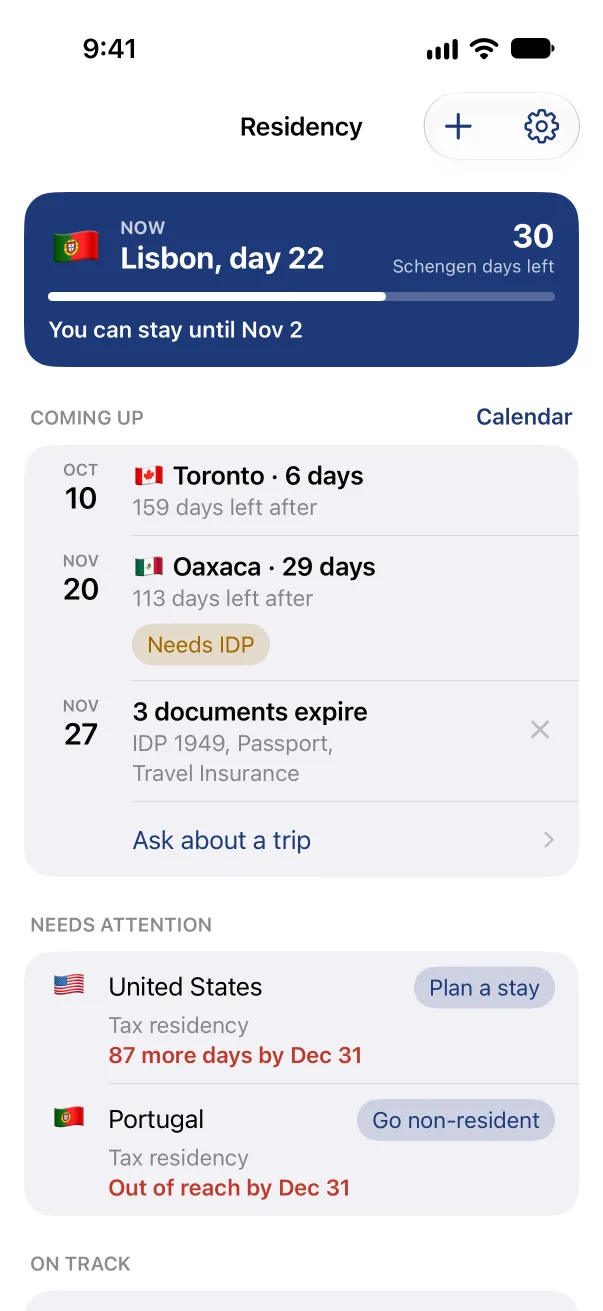
Residency counts your days in each country and tracks thresholds such as the IRS substantial presence test. You set the goal once and it warns you while there is still time to change a booking.
Updated 11 November 2026.
Questions
Is the 183-day rule the same in every country?
No. Countries differ on the year they count over, on whether earlier years count, and on what else can make you resident with fewer days.
Can I be tax resident with fewer than 183 days?
Yes, in several countries. In the UK, for example, HMRC's sufficient ties test can make you resident on as few as 16 days if you have enough ties.
Does the United States use a 183-day rule?
It uses a weighted one. The IRS counts all your days this year, a third of last year's and a sixth of the year before, and the total has to reach 183 with at least 31 days this year.